
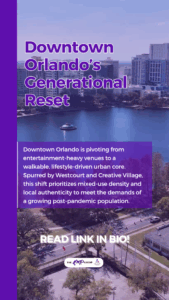
For years, Downtown Orlando was defined by its “neon and noise”—a destination built largely around massive entertainment venues, high-volume nightlife, and the 9-to-5 office grind. But if you walk through the city today, you’ll notice the skyline isn’t the only thing changing. A generational retail evolution is underway, shifting the city’s heart from a weekend destination to a 24/7 “living room.”
This isn’t just a post-pandemic recovery; it’s a complete reimagining of what an urban core should look like.
From “Big Box” Entertainment to Human-Centered Living
The old model of downtown retail relied on the “event-goer”—someone who drove in for a Magic game or a concert and left immediately after. Today, the focus has shifted toward the resident and the remote worker.
We are seeing a move away from isolated, large-scale venues toward a lifestyle-driven model. This new approach prioritizes:
-
Walkability: High-density designs that favor pedestrians over parking lots.
-
Authenticity: A surge in local boutiques and “third spaces” (cafes and parks) over generic chains.
-
Mixed-Use Integration: Apartments, offices, and shops co-existing in the same footprint.
The Catalysts: Westcourt and Creative Village
Two massive projects are acting as the north stars for this transformation:
-
Westcourt: Located just north of the Kia Center, this $500 million project is more than just an expansion of the sports district. With 270 high-rise apartments, a boutique hotel, and 120,000 square feet of retail, it’s designed to be a “fully activated” hub. Its central “Urban Living Room”—1.5 acres of green space—will host everything from farmers markets to outdoor movies, proving that community, not just commerce, is the new priority.
-
Creative Village: Occupying 68 acres on the former Amway Arena site, this “Innovation District” has already introduced thousands of students and professionals to the core. By blending education (UCF/Valencia) with high-tech anchors like Electronic Arts (EA), it has created a built-in audience for the local restaurants and parks that make a neighborhood feel like home.
Why It’s Happening Now
This shift is the result of a perfect storm. Rapid population growth in Central Florida has created a demand for urban density that Orlando hasn’t seen in decades. Simultaneously, the “post-pandemic reset” changed what we value. Consumers are no longer looking for “stuff”; they are looking for experiences and connection. They want to grab a coffee, walk to a local park, and shop at a store where the owner knows their name.
Downtown Orlando is shedding its image as a place you only visit for a “night out.” By embracing human-centered design and mixed-use density, the city is building a resilient, vibrant ecosystem where people can truly live, work, and play in a single, walkable footprint.
The era of the “destination” is fading; the era of the neighborhood has arrived.